Production SaaS on a proven foundation · .NET / C#
The fastest way to an MVP you'll never have to rebuild.
AI devs and vibe coding get you a demo, then a rewrite once you hit real scale. I build your product on a foundation that already carries 3,500+ tests if you sell to consumers, 6,500+ if you sell to businesses. One engineer, no account managers, no handoffs.
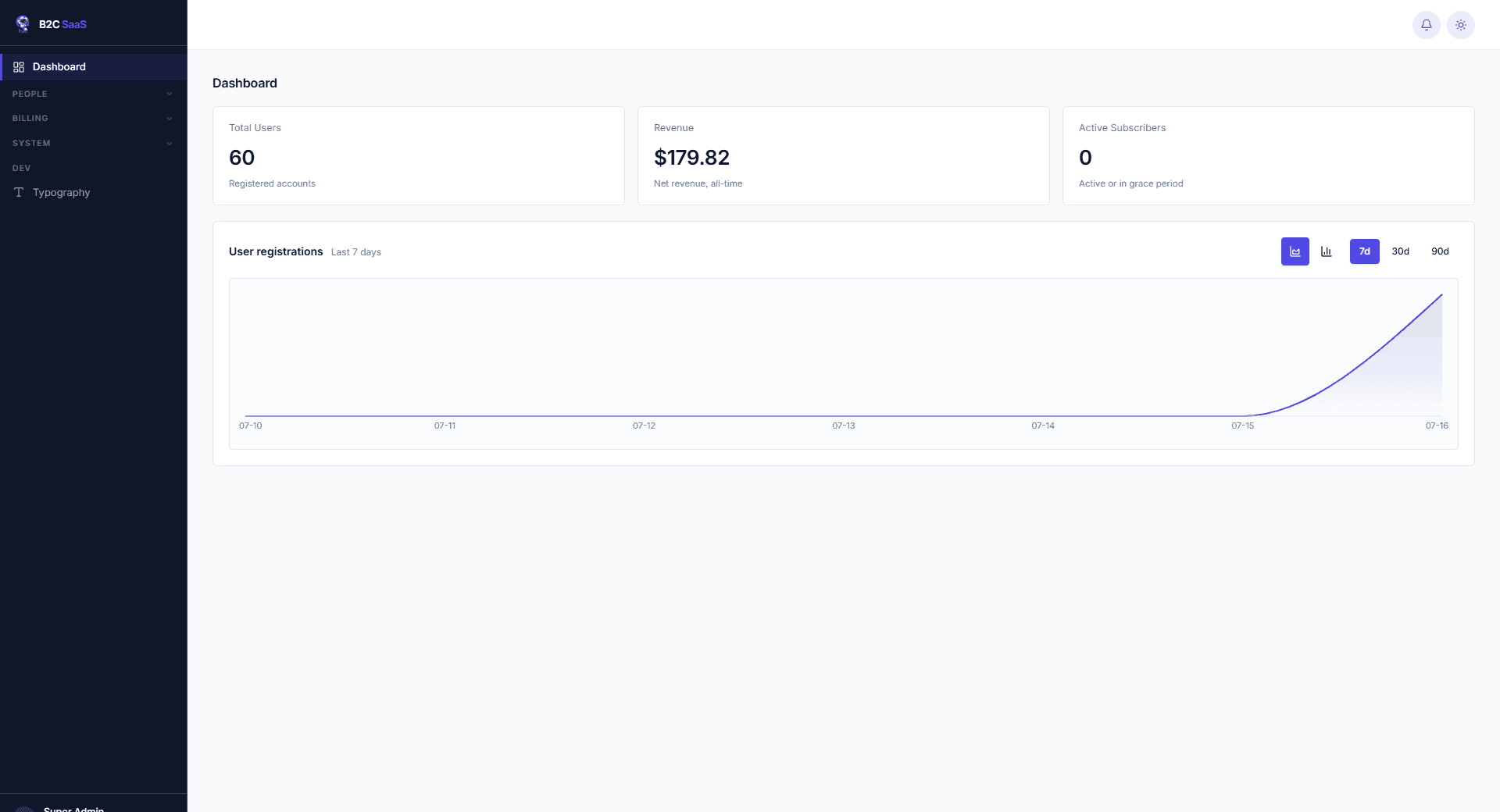
- 1Auth — ASP.NET Identity · social login · MFA · sessions
- 2Billing — RevenueCat · subscriptions · failed-payment handling
- 3Subscribers: 0 — Grace-period logic, tested before the first subscriber existed
- 4Dashboard reads — Compiled queries · L1/L2 cache · in-memory + Redis
The rebuild is what success costs you.
A throwaway MVP is cheaper, but only if it fails. Nobody rewrites a product nobody uses. The rewrite arrives precisely when it works: real users, real data, real money, and a codebase that can't carry any of it. You pay for the second build at the one moment you should be pulling ahead.
Vibe-code or hire AI devs. Demo in weeks
Your features on a foundation that already solved auth, billing, tenancy, and jobs: 3,500+ tests behind it if you're user-gated, 6,500+ if you're tenant-gated
Get users. Auth strains, billing edge cases pile up, tenancy bugs surface
Get users. The plumbing was built and tested before you launched, not discovered under load
Hire real engineers to rebuild, under production load, with live data to migrate
Keep shipping features, because there is nothing to rebuild
Pay twice, and the second time costs more. Lose months at exactly the moment you had momentum.
Scale on what you launched with, to 100k+ users on resource upgrades alone.
- 01Vibe-code or hire AI devs. Demo in weeks
- 02Get users. Auth strains, billing edge cases pile up, tenancy bugs surface
- 03Hire real engineers to rebuild, under production load, with live data to migrate
- 04Pay twice, and the second time costs more. Lose months at exactly the moment you had momentum.
- 01Your features on a foundation that already solved auth, billing, tenancy, and jobs: 3,500+ tests behind it if you're user-gated, 6,500+ if you're tenant-gated
- 02Get users. The plumbing was built and tested before you launched, not discovered under load
- 03Keep shipping features, because there is nothing to rebuild
- 04Scale on what you launched with, to 100k+ users on resource upgrades alone.
Materials & test certificate
Don't take the numbers on faith. Read the code.
WorklaneOS, the software I run Ashersoft on, is built on one of the foundations. I don't sell anything I don't run myself.
Two foundations. Two architectures.
Your product on top.
The only architecture decision you make is the gate: does your product charge people, or companies? Everything behind that gate is already built and tested.
One deployable with folder-based module boundaries, simple to run and fast to iterate. Identity, subscriptions, and entitlements gate per user.
Project-bounded modules that extract into services when scale demands it, with no rewrite. Data isolation, seats, roles, and audit gate per tenant.
Either way you scale on what you launched with, to 100k+ users on resource upgrades alone. Past that, it's a conversation, not a rewrite.
Full foundation breakdown→Fixed scope. Four steps. No retainer bleed.
A free call to understand what you're building and which gate fits: user or tenant.
Clear deliverables, honest timeline, one price. If scope changes, I re-quote and you decide.
Your features start where the plumbing ends. Weeks to MVP, not quarters.
Full source of your product, docs, and tests. The foundation stays licensed; see how it works.
You get the full source code of your product, including the foundation it runs on: build, host, and modify it freely for your business. The foundation IP stays with me, so you can't redistribute it or build new products on top of it.
Details on the pricing page→Build it once.
Scale on it.
Tell me what you're building, or what your AI-built MVP is struggling with. I reply within 24 hours with an honest read.